

Market Outlook for the 2027 Financial Year
Market Outlook for the 2027 Financial Year
Summary
- Favour quality businesses with pricing power, resilient earnings and strong balance sheets as economic growth moderates.
- Resource companies and selected industrials remain well supported, while domestic-oriented sectors and banks face a more challenging backdrop.
- Higher bond yields and continued opportunities in global equities reinforce the value of maintaining diversified portfolios.
Navigating complexity
The investment environment has become increasingly complex as we enter the new financial year. Markets are being shaped not only by company fundamentals, but by a combination of macroeconomic, political and structural forces. The result is a backdrop where volatility is likely to remain elevated and market leadership may continue to shift rapidly.
During periods of negative news flow, investors often worry about entering the market at the wrong time. This can lead to delayed investment decisions or a move to cash, potentially causing investors to miss subsequent recoveries.
However, long-term market data consistently demonstrates that remaining invested typically produces better outcomes than attempting to time market movements.
Rather than trying to time the market, successful investing relies on patience and focusing on long-term outcomes, where short-term volatility is outweighed by the benefits of compounding returns. Historical performance reinforces this point, with well-structured portfolios delivering solid returns over time despite periods of uncertainty.
Diversification across asset classes, sectors and regions remains one of the most effective tools available to investors. Markets rarely move in lockstep, and leadership can shift rapidly between sectors, countries and asset classes.
The 2026 financial year provides a good example, with Australian equities generating a total return of 6.6%, while international equities (MSCI World ex Australia Index hedged) delivered a much stronger 21.7% gain. Investors concentrated solely in the Australian market would have missed a significant portion of these broader gains.
Ultimately, the key is to build a well-diversified portfolio aligned with clear goals and to remain disciplined through market fluctuations.
A quick recap of FY26
International shares stood out in the 2026 financial year as AI-related stocks powered ahead. The global index on a currency-hedged basis returned 22.7%, outpacing the unhedged equivalent at 14.9%. The difference between the two neatly illustrates Australian dollar strength over the period.
Australian shares generated a respectable 6.1% total return, although this clearly lagged the strong gains delivered by global equities. Listed property delivered a negative return as higher interest rates and ongoing inflation concerns weighed on valuations.
Within defensive assets, variable-rate hybrids returned 5.9% (7.7 % on a grossed-up basis), comfortably outperforming cash at 3.9% and traditional fixed interest at 1.5%, reflecting a challenging year for duration-sensitive assets.
Chart 1: FY26 Asset Class Returns
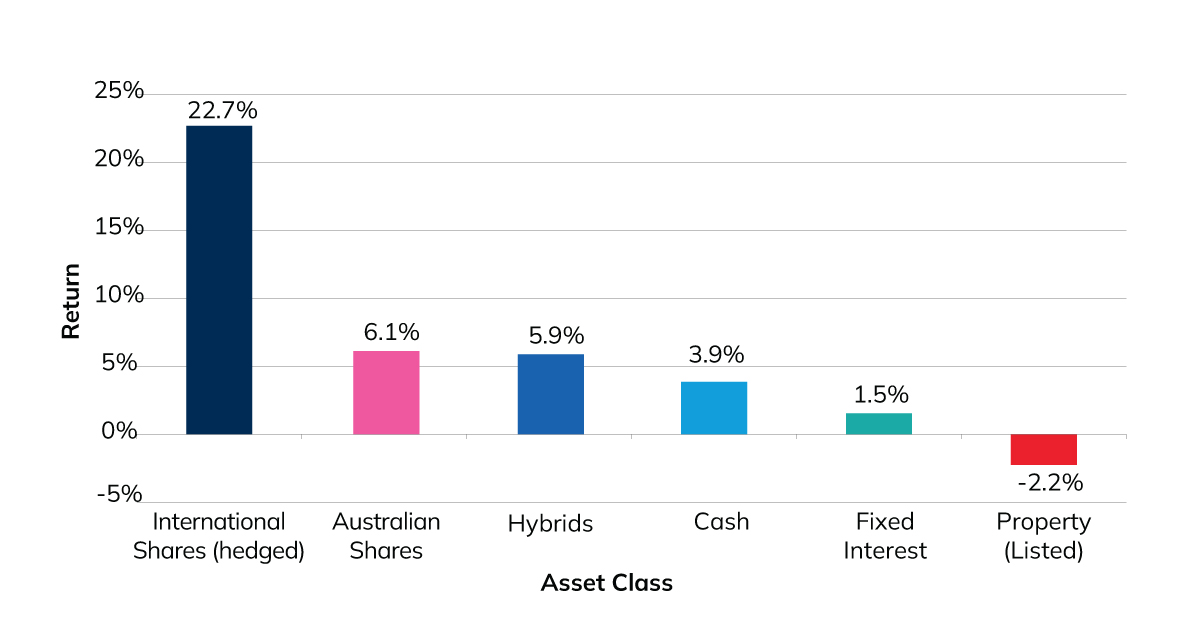
Source: Bloomberg, Iress, Morningstar. Aust. Shares: ASX 200 Accum. Index. Intl. Shares: MSCI World ex-Australia Accum. Index (100% hedged). Property: S&P/ASX 200 A-REIT Accum. Index. Fixed Interest: Bloomberg Composite All Series/All Mat. Accum. Cash: Bloomberg Bank 0+. Hybrids: Solactive Aust. Hybrids Index (Net)
Sector allocation was the dominant driver of returns in the Australian market (refer Chart 2), with a spread of roughly 89 percentage points between the best-performing sector, Materials (+52.1%), and the worst, Information Technology (-37.0%). Holding an overweight position in Materials, or underweight Information Technology and Health Care, determined a large proportion of portfolio performance.
Materials strength was broad, spanning iron ore, gold, lithium, rare earths and the diversified miners, and did much of the work in lifting the index to its 6.1% return.
Information Technology and Health Care were dragged down by heavyweight declines in Cochlear, CSL, WiseTech and Xero, masking strong gains from smaller names such as 4DMedical, Codan and Megaport.
Financials finished just positive, but ANZ and Westpac outperformed while CBA and NAB lagged. Real Estate and Communication Services showed similarly wide dispersion, highlighting that stock selection is also an important factor in portfolio construction.
Chart 2: FY26 Australian Sector Returns
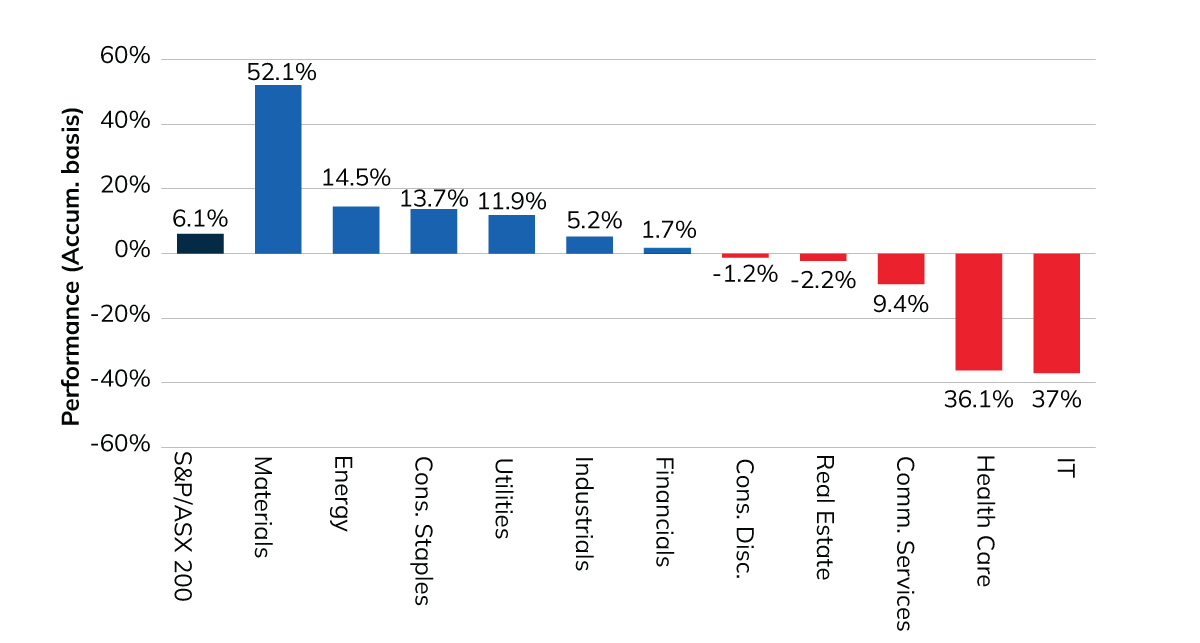
Source: Iress
A evolving macro backdrop
We take a constructive view of the current macro backdrop, which we see as a period of transition rather than fragility. While inflation risks are present, recent geopolitical developments, including easing tensions in the Middle East, have already helped stabilise some of the most volatile components of inflation, such as energy prices.
Central banks, including the Reserve Bank of Australia, may therefore maintain a more cautious stance for longer, but this is ultimately aimed at anchoring inflation expectations and supporting long-term economic stability.
Higher interest rates are moderating economic growth, but this should be viewed in the context of a normalisation following an extended period of exceptionally accommodative monetary policy. The increasing role of supply-side factors in inflation, including those linked to agriculture and climate conditions, highlights areas where investment, innovation and productivity gains are likely to emerge over time. We are cognisant of risks such as the H5N1 avian flu or a potential “super El Niño” weather pattern creating short-term uncertainty, but they also reinforce the adaptability of global supply chains and the importance of developing and investing in resilience.
Housing and consumers feel the heat
The Australian housing market remains a central pillar of the economy. Clearly there is some moderation following a series of rate rises and the effects of recent tax changes. However, underlying demand, population growth and structural supply constraints provide important support.
Consumer-facing sectors are experiencing a period of adjustment as higher interest rates and cost pressures flow through. Encouragingly, many businesses are responding through improved cost discipline, pricing strategies and operational efficiency, positioning themselves well for the next phase of growth.
Earnings momentum adjusts
Earnings trends across the market reflect this transition. While earnings downgrades have become more widespread, this largely reflects a recalibration of expectations rather than a meaningful deterioration in overall corporate health.
At the same time, there are clear areas of strength. Resources continue to be supported by solid commodity prices, while energy companies have benefited from higher oil prices. Industrial companies exposed to long-term structural themes, such as defence spending and digital infrastructure, are also buoyant.
Looking ahead, there is a reasonable pathway to improved earnings conditions, particularly in consumer sectors, as the eventual easing of monetary policy will support demand.
Chart 3: ASX 200 Consensus EPS Growth Forecasts
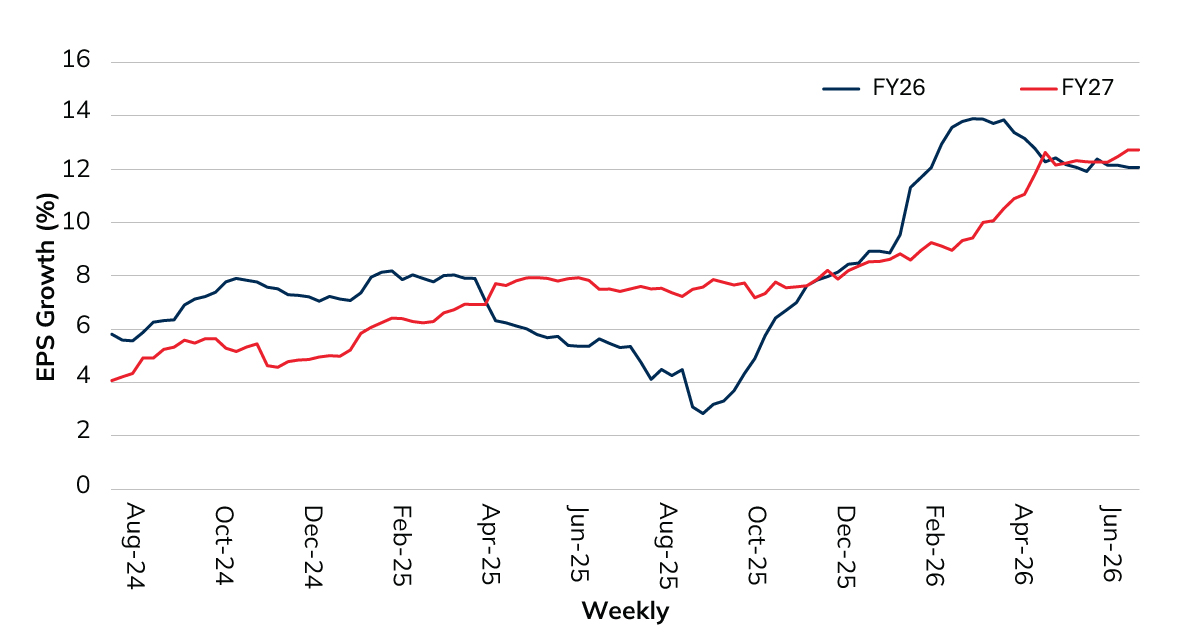
Source: Ord Minnett Research, Workspace
The shift to a structurally higher cost of capital is another defining feature of the current environment. While this places some pressure on valuations, it also promotes greater discipline in capital allocation and rewards businesses with strong balance sheets and sustainable cash flows. In this context, quality becomes increasingly important, creating a more favourable environment for fundamentally strong companies to differentiate themselves.
The growing influence of artificial intelligence
At the same time, artificial intelligence continues to develop as a powerful structural driver of growth across global markets. Its influence extends well beyond equity markets.
Debt markets are absorbing substantial issuance from technology companies funding AI investment, while infrastructure spending is increasingly directed towards supporting rising energy consumption and data requirements. Real estate markets are being reshaped by demand for data centres, and private market investors are reassessing existing business models for both opportunity and disruption.
The scale of capital being directed towards AI and supporting infrastructure highlights both the magnitude of the opportunity and the technology's potential to transform economic activity.
While the pace of investment is significant and raises valid questions around returns and competitive dynamics, this is consistent with previous periods of technological change. Over time, such investment has historically translated into productivity gains and new revenue opportunities. The expansion of AI capabilities is likely to follow a similar path, supporting long-term economic growth even as the near-term outlook evolves.
Portfolio implications
In this environment, active stock selection becomes increasingly important. The broadening of earnings downgrades suggests that index-level returns may mask a wide dispersion of outcomes at the stock level.
Our Australian equities positioning remains cautious on sectors with high domestic exposure, particularly consumer discretionary and real estate. Financials face a more challenging operating environment, with pressure on margins and growth.
At a sector level, Materials and selected Industrial businesses appear relatively well supported, particularly where they benefit from favourable structural trends, pricing power or strong competitive positions. More broadly, we favour businesses with:
- Defensive and resilient earnings profiles
- Strong market positions and pricing power
- Disciplined cost management
- Balance sheet strength
In the current environment, these characteristics are increasingly important in differentiating winners from losers. Examples include insurers with strong pricing power, such as Medibank Private and QBE, as well as Telstra among telcos. In the consumer space, Coles, JB Hi-Fi Qantas, Sigma Health and Woolworths maintain strong market positions and discipline. Defensive income sources include APA Group, Dalrymple Bay Infrastructure, The Lottery Corporation, Transurban and Vicinity Centres.
We expect strength in the commodity cycle to continue supporting resource companies. We favour Newmont, Rio Tinto, Sandfire Resources and South32 among large caps. In the energy sector, Ampol is well-placed as Middle East concerns soften.
Slowing credit growth, however, will remain a headwind for the banking sector but there are some key ideas in the broader financial services sphere including Challenger, Cuscal and Macquarie Group.
For value-focused investors, sectors such as information technology and healthcare, which have been so heavily sold off, will appear tempting but certainty around their earnings turnaround will prove important.
International equities continue to offer attractive long-term opportunities, although returns are likely to be increasingly driven by company fundamentals rather than broad market expansion. After several years of strong gains, valuations in parts of the market, particularly large-cap US technology stocks, remain demanding and leave less room for disappointment. Our favoured international Exchange Traded Funds include iShares Global 100 Core (IOO), Plato Global Alpha (PGA1) and Vanguard Global Value (VVLU), and in emerging markets, JPM EM Research Enhanced Index (JEME). In real assets, the Lazard Global Listed Infrastructure Active ETF (GIFL) has been a standout.
The outlook for fixed interest has improved relative to recent years, with higher starting yields providing a more attractive income stream and a greater cushion against market volatility. As inflation moderates and policy rates approach a more stable footing, bonds are once again positioned to fulfil their traditional role as a source of income and portfolio diversification.
We expect high-quality government and investment-grade corporate bonds to deliver reasonable risk-adjusted returns, particularly if economic growth slows further. Credit spreads remain relatively tight by historical standards, limiting the scope for significant capital gains, but the income available from quality fixed interest assets remains compelling.
Core Australian fixed interest ETF exposures include iShares Core Composite Bond Fixed (IAF) and the Janus Henderson Tactical Income Active ETF (TACT). For international exposure, consider Coolabah Global Floating Rate High Yield Complex (YLDX) and Vanguard Global Aggregate Bond Index (Hedged) (VBND).
Cash remains an important defensive asset, providing liquidity and flexibility during periods of market uncertainty. However, investors should be mindful that over the long term, excessive allocations to cash may struggle to keep pace with inflation and the return potential available from equities and other growth assets.
Conclusion
The financial year ahead is likely to be characterised by macroeconomic uncertainty, persistent inflation risks and ongoing structural change. Markets are adjusting to an environment where the cost of capital matters more, policy outcomes are less predictable, and earnings growth is becoming increasingly selective.
For our clients, this reinforces the importance of disciplined portfolio construction, diversification and a focus on quality. While periods of uncertainty can be uncomfortable, they also create opportunities for patient, long-term investors. Maintaining a disciplined investment approach and focusing on quality assets has historically rewarded investors through a wide range of market environments.
Important information: This webpage provides general information only and does not constitute financial, investment, or tax advice, and should not be relied on to make financial, investment or taxation decisions. Individuals should seek professional advice tailored to their specific circumstances before making any decisions.
Insights that count
Discover the best opportunities to outperform the market. Our research team dig deep into the market, company and stock data to bring you insights others might overlook.
AFR: Ord Minnett eyes bigger slice of small-cap equities, hires analysts
Ord Minnett’s Alastair Hunter and Angus Esslemont spoke to the...


Forbes: The Aussie Dollar Is Falling: Should Your Investments Change?
The Australian dollar has been weakening in 2023 and sits at US64...

Ord Minnett named Major Sponsor for Water Polo Australia
Ord Minnett is proud to announce it is the new Major Sponsor of...


.webp)