

The Cloud and the Quarry
August 13, 2026
By Anders Sörman-Nilsson
An energy story: does Australia own its future or rent it out?
Technology is geology. Peel away the science-fiction shimmer from artificial intelligence and that is what you are left with. We talk about AI as if it floats up in the virtual cloud, weightless and clean. It does not. Every question we put to Claude or ChatGPT pulls electricity through tonnes of copper, across silver contacts, cooled by fans spinning on rare earth magnets, inside windowless sheds on the fringes of Sydney and Melbourne, humming around the clock on megawatts. Every industrial revolution eventually meets something physical it cannot wish away. The railways needed steel, the motor age needed oil, the internet needed fibre, and this one needs electrons, water and a power grid. What will decide who wins this decade is not just how clever the chips become, nor how scarce the talent is. It is something far more old-fashioned, which is power and natural resources.
I have a name for this fusion of worlds. I call it Digilogue: the convergence of the digital and the analogue, the virtual and the physical. Digital minds, analogue hearts. The rest of this publication brings you the data and the analysis. My job is the story beneath the numbers, because a story, in the end, is data with a soul. Last quarter these pages asked which software businesses survive once AI collapses the cost of writing software. I want to go one physical layer beneath that, down to the power stations, substations and copper cables that must exist before any of the clever stuff can even run. That is where the real scarcity, and much of the real opportunity, quietly sits.
Consider the scale. Global data centre electricity demand grew 17% in 2025, with the AI slice up by around half,¹ and on the central case it roughly doubles to about 945 terawatt-hours by 2030, getting on for 3% of all the electricity on the planet,² enough to power something like 150 million homes. If the world’s data centres were a country, they would rank among the five largest power consumers on Earth, between Japan and Russia.³ The money is just as staggering. The five biggest American tech firms are guiding towards US$600 to US$700 billion ($870 billion to $1 trillion) of capital spending in 2026 alone, three-quarters of it on AI,⁴ and Morgan Stanley reckons the global build nears US$3 trillion by 2028, much of the gap raised as debt.⁵ A gigawatt, roughly one large power station, is the currency everyone now trades in. These sheds take up plenty of land, but what they are really scrambling for is power.

So where does Australia sit? Closer to the centre of the global AI infrastructure race than most of us assume. The Australian Energy Market Operator (AEMO), the body that runs the grid across the eastern states, expects data centre demand on the National Electricity Market (NEM) to triple to around 12 terawatt-hours a year by 2030, about 6% of the grid, and to climb towards 12% by mid-century.⁶ That is roughly the annual electricity use of two million homes, near-enough every household in Sydney.⁷ Meeting it, on top of the energy transition, is part of why AEMO’s latest blueprint puts the cost of the generation, storage, firming (back-up for when the wind drops and the sun sets) and transmission needed by 2050 at around $106 billion, including some 6,000 kilometres of new transmission line.⁸
Here is where the hype meets the wiring. Data centre developers have lodged something like 44 gigawatts of connection requests with the networks, yet AEMO expects only about six gigawatts of it to actually materialise.⁹ The eastern grid has never drawn much beyond 35 gigawatts at once, so the paper queue alone is larger than the entire grid at full stretch. Six out of every seven megawatts being asked for is what engineers drily call phantom demand, flags planted in the ground by developers hedging their options, most of which will never plug in. Booms tend to begin this way, with expectation racing ahead of reality, as it did in the railway mania of the 1840s and the dot-com fibre glut of the late 1990s. The point, for an investor, is what the froth leaves behind. When far more power is requested than the grid can ever deliver, the genuinely scarce and bankable asset is not a press release, but a firm, deliverable connection to real electricity. That, and not the hype, is the bottleneck worth owning.
The consequences run well beyond the power bill. These machines are hungry for energy and thirsty for water, and we are attempting this on the driest inhabited continent on Earth. Sydney Water projects that data centres could draw as much as a quarter of the city’s available water by 2035, on its own figures, and while efficient and recycled cooling can cut what any single site takes, the worry is the combined strain on a city that leans on one dam and a desalination plant. That is before you even count the water used upstream to generate their electricity, since the coal and gas plants that make much of our power are thirsty too, boiling water into steam to spin their turbines.¹⁰ One proposed site in Sydney’s west would draw 1.2 gigawatts, more than the country’s largest aluminium smelter, enough to light well over a million homes.¹¹ These are real megawatts and megalitres that households, farmers and factories also wanted.
Which brings us back to where we began. Technology is geology. Not a single prompt, not one AI agent, happens without copper for the cabling, silver for the contacts, and steel for the racks, the buildings and the transmission towers, all of it dug out of the ground first. By someindustry estimates a single large hyperscale data centre can use up to 50,000 tonnes of copper, and S&P Global, the ratings and commodities research house, expects copper demand to rise by about half, to some 42 million tonnes a year by 2040, even as mine supply peaks around 2030. They call the gap a systemic risk.¹² For a country whose prosperity has long been built on what it digs up and ships out, that crunch could be a front-row seat to the next commodity supercycle.
There is an old gold-rush truism, that the people who got rich were the ones selling picks and shovels, not the prospectors. The picks and shovels of this rush are power, copper, cooling and grid connections, and Australia is unusually well stocked in that layer. The capital is already arriving, $20 billion from Amazon, $25 billion from Microsoft, and an OpenAI and NEXTDC sovereign campus at Eastern Creek.¹³ With stable institutions, sun, wind, land and ever deeper subsea fibre, now including the new 5,000 kilometre SMAP cable linking our capital cities, we look, on paper, like the perfect host, provided we can power all this sustainably and carry the community with us.¹⁴ That second condition is not a given.
From Sydney’s west to regional NSW,councils and residents are already pushing back on the noise, the water and the strain on the grid, and a state inquiry is now weighing how much social licence the sector really holds.¹⁵ This is not a soft concern: in the US, local opposition cancelled more than US$42 billion of data centre projects in the first quarter of this year alone. Win the land and the power, and you can still stall without the community’s consent.
And host is the descriptor to pause on, because we have run this play before, digging things up and shipping them out, then buying the finished product back at a premium. The temptation with AI is the same in fancier dress, renting out the land, the resources and the power, then importing the intelligence back as a subscription. In that version we own the paddock and the substation, while someone on the other side of the world owns the model, the margins and the sci-fi future.
There is a real opportunity cost here, and not one you can measure purely in dollars. Every gigawatt, megalitre and kilometre of transmission we give to hosting someone else’s computing power is a choice about what kind of economy we want to be. Policymakers can see it. The federal government’s December 2025 National AI Plan, and its March 2026 Expectations of data centre developers, which ask for local engineers, sustainability, Australian supply chains and a genuine social licence, are an honest attempt to turn tenancy into future capability.¹⁶ So what does it mean for you? Stock selection belongs with your Ord Minnett adviser and the analysts whose work fills these pages. My job is to point at where the ground is shifting, the megatrends, the second-order impacts. The scarce resources of this build are power, water, copper, sovereign capability and, increasingly, the unglamorous right to connect, the approvals and grid access that can take years to secure and that investors routinely underestimate.¹⁷ The durable value of the coming decade will gather around whoever owns those bottlenecks, the geology beneath the technology, far more than around the hyperscalers who rent the racks or the contractors who pour the slab.
The cloud, it turns out, is hungry for power, thirsty for water, and built out of a quarry. And the one question still worth asking, the one I would leave with every Australian investor, is whether we end up owning the cloud, owning the quarry, or holding nothing more than the lease in between?
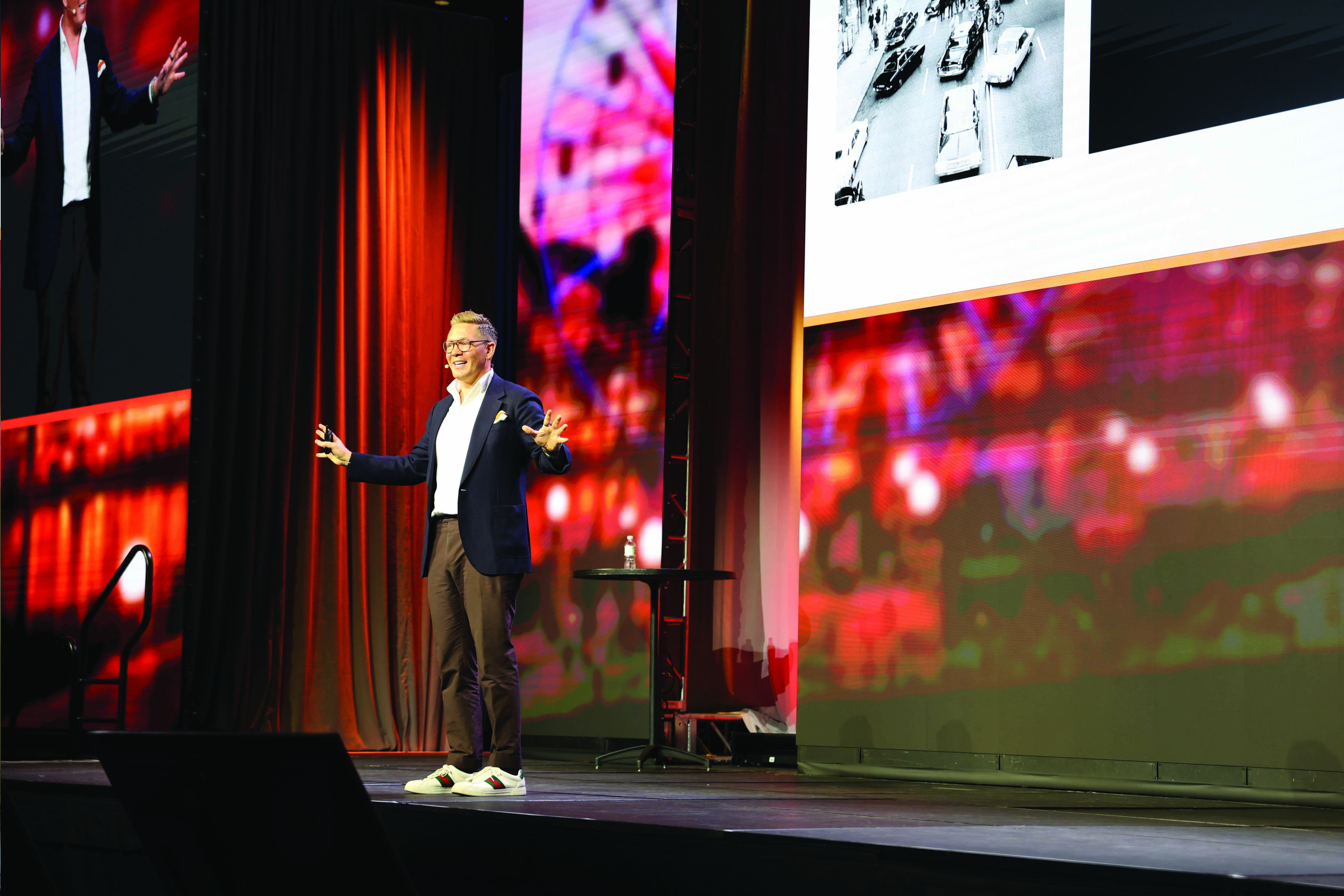
About the author
Anders Sörman-Nilsson is a Swedish-Australian futurist, founder of the think tank Thinque, and Ord Minnett’s Futurist-in-Residence. An outside-in provocateur and cultural translator, he helps organisations read the long arc of AI, digital transformation and future-readiness. His work has featured in The New York Times, The Wall Street Journal, the BBC, the Australian Financial Review and Monocle, and he has worked with global brands including Adobe, Google, Microsoft and BMW.
¹International Energy Agency, Key Questions on Energy and AI (April 2026): “the global electricity demand of data centres … grew by 17% in 2025” and “electricity consumption from AI-focused data centres … surging 50% in 2025.” https://www.iea.org/reports/key-questions-on-energy-and-ai/executive-summary
²IEA, Energy and AI (2025): base case of about 945 TWh by 2030, just under 3% of global electricity, which the IEA notes is slightly more than Japan’s entire consumption today. The 150 million homes figure assumes an average home uses about 6 MWh a year. https://www.iea.org/reports/energy-and-ai/energy-demand-from-ai
³Brookings Institution, “Global energy demands within the AI regulatory landscape” (April 2026). https://www.brookings.edu/articles/global-energy-demands-within-the-ai-regulatory-landscape/
⁴CNBC, “Tech AI spending approaches $700 billion in 2026” (6 February 2026); Microsoft’s roughly US$190bn 2026 guidance reported by Tom’s Hardware (April 2026). https://www.cnbc.com/2026/02/06/google-microsoft-meta-amazon-ai-cash.html | https:// www.tomshardware.com/tech-industry/big-tech/big-techs-ai-spending-plans-reach-725-billion
⁵Morgan Stanley Research, “Who Will Fund AI’s $3 Trillion Ask?” (2025): about US$2.9 trillion of global data centre capex through 2028, with a roughly US$1.5 trillion gap to be met from external capital, much of it debt. Corroborated by Fortune (December 2025). https://www.morganstanley.com/insights/podcasts/thoughts-on-the-market/ai-investing-credit-markets-andrew-sheets | https://fortune.com/2025/12/04/morgan-stanley-significant-risk-transfer-loans-data-center-ai-infrastructure-exposure/
⁶AEMO and Oxford Economics Australia, Data Centre Energy Demand, Final Report (July 2025): demand to triple to about 12 TWh by FY30 (around 6% of the NEM) and about 34.5 TWh by FY50 (around 12%). https://www.aemo.com.au/-/media/files/stakeholder_consultation/consultations/nem-consultations/2024/2025- iasr-scenarios/final-docs/oxford-economics-australia-data-centre-energy-consumption-report.pdf
⁷Conversions to households assume an average Australian home uses about 6 megawatt-hours (roughly 6,000 kilowatt-hours) of electricity a year; usage varies by state and household size. Australian Energy Regulator residential benchmarks. Greater Sydney has roughly two million households. https://www.aer.gov.au/
⁸AEMO, 2026 Integrated System Plan (final, published 25 June 2026): the Step Change optimal development path requires about A$106 billion of investment to 2050 across generation, storage, firming and networks, revised down from A$128 billion in the December 2025 draft, with around 6,000 km of new transmission added to the existing 44,000 km grid. https:// www.aemo.com.au/energy-systems/major-publications/integrated-system-plan-isp/2026-integrated-system-plan-isp | https://reneweconomy.com.au/ households-lead-march-to-least-cost-electricity-as-aemo-issues-call-to-arms-on-renewable-transition/
⁹Oxford Economics Australia, “Estimating Data Centre Phantom Demand” (commissioned by AEMO, January 2026): of 44 GW of data centre connection requests lodged with Network Service Providers in the 2025 IASR, only about 6 GW is expected to materialise under AEMO’s Step Change scenario. The NEM’s record maximum demand sits around 35 GW. https:// www.oxfordeconomics.com/resource/estimating-data-centre-phantom-demand/ | https://datacentres.org.au/wp-content/uploads/2026/02/2025-11_Oxford- Phantom-Demand-Research-Briefing.pdf
¹⁰Sydney Water projections shared with Reuters: data centres could account for up to a quarter of Sydney’s available water by 2035, about 135 gigalitres, a figure that already assumes operators meet water-efficiency goals. Recycled and air-cooled systems can cut a single site’s draw sharply; the concern is the aggregate strain on a city served by one dam and a desalination plant. See also Water Services Association of Australia, Data Centres and Water in Australia (December 2025). Thermal generation is itself water-intensive, so grid power carries an additional, indirect water cost. https://www. cnbc.com/2025/09/16/in-australia-a-data-center-boom-is-built-on-vague-water-plans.html | https://smartwatermagazine.com/news/smart-water-magazine/ australia-sets-rules-what-new-data-centre-policies-mean-water-sector
¹¹Climate Council, “Seizing the opportunity to do data centres right” (2026): the proposed 1.2 GW Mamre Road facility would exceed the 950 MW Tomago aluminium smelter. Run continuously, 1.2 GW delivers about 10 TWh a year, comparable to well over a million average homes. https://www.climatecouncil.org. au/what-does-the-data-centre-boom-mean-for-australias-switch-to-renewables/
¹²S&P Global, Copper in the Age of AI: The Challenges of Electrification (8 January 2026): copper demand projected to rise about 50% to 42 million tonnes by 2040 against a supply gap S&P calls a “systemic risk”, with primary mine supply peaking near 33 million tonnes around 2030. The per-facility figure of up to about 50,000 tonnes (roughly 47 tonnes per megawatt) for a large hyperscale site is an industry estimate, not S&P’s. https://www.spglobal.com/en/research-insights/special-reports/copper-in-the-age-of-ai
¹³Amazon (AWS), A$20 billion 2025 to 2029 commitment (June 2025); Microsoft, A$25 billion commitment to 2029 (announced 23 April 2026); OpenAI and NEXTDC sovereign AI campus at Eastern Creek. https://www.aboutamazon.com/news/aws/amazon-data-center-investment-in-australia | https://news.microsoft.com/source/asia/features/investing-in-australias-ai-future/ | https://datacentremagazine.com/news/how-will-nextdc-ai-campus-drive-openai-for-australia
¹⁴SMAP, a 5,000 km transcontinental subsea cable linking Sydney, Melbourne, Adelaide and Perth, is coming online in early 2026 as the first stage of the HyperOne backhaul network; Google-backed Pacific cables such as Tabua and Honomoana are also landing on Australian coasts. https://www.datacenterdynamics.com/en/news/subco-lands-smap-cable-in-perth/ | https://www.submarinecablemap.com/submarine-cable/sydney-melbourne-adelaide-perth-smap
¹⁵Industry coalitions, councils and residents arewarning that data centres risk losing social licence without local benefit andfirmed renewable power. Penrith City Council objected to a large Western Sydneyproposal over water, noise and grid impacts, echoing a wider community backlashnow visible across the United States and Britain. The Economist (23 June 2026)reports the opposition has hardened into a material risk to projects. https://www.pv-magazine-australia.com/2026/06/18/data-centres-must-bring-new-green-power-and-public-benefit-as-binding-conditions-of-approval/ | https://ia.acs.org.au/article/2026/concern-over-australia-s-most-power-hungry-data-centre.html
¹⁶Australian Government, Department of Industry,Science and Resources: National AI Plan (December 2025) and Expectations ofdata centres and AI infrastructure developers (23 March 2026); AI andautomation projected to add up to A$600 billion a year to GDP by 2030. https://www.industry.gov.au/publications/expectations-data-centres-and-ai-infrastructure-developers | https://www.industry.gov.au/news/developing-national-ai-capability-plan
¹⁷Planning approval is now among the mainconstraints on Australian data centre development, with some NSW assessmentstaking close to two years; a NSW Legislative Council inquiry is due to reportby 30 September 2026 and the AEMC has drafted new grid-connection rules forlarge loads.
Insights that count
Discover the best opportunities to outperform the market. Our research team dig deep into the market, company and stock data to bring you insights others might overlook.
AFR: Ord Minnett eyes bigger slice of small-cap equities, hires analysts
Ord Minnett’s Alastair Hunter and Angus Esslemont spoke to the...


Forbes: The Aussie Dollar Is Falling: Should Your Investments Change?
The Australian dollar has been weakening in 2023 and sits at US64...

Ord Minnett named Major Sponsor for Water Polo Australia
Ord Minnett is proud to announce it is the new Major Sponsor of...


.webp)