

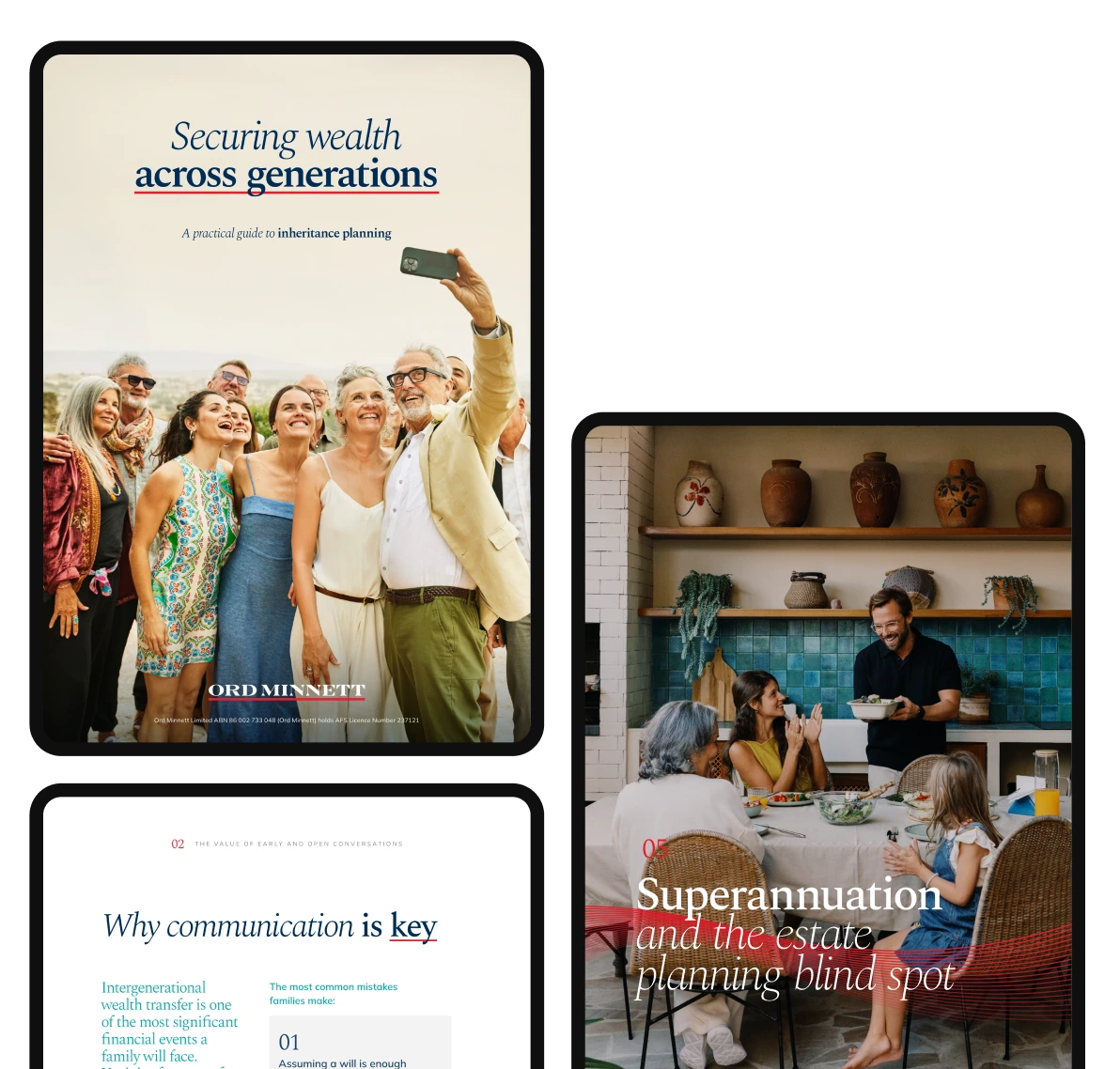
Securing wealth across generations: a guide to inheritance planning
Over the coming decades an estimated $5.4 trillion in wealth will be passed on from Australians over the age of 60.
This will be a seismic shift in the financial lives of millions of Australians and is called the great intergenerational wealth transfer.



What is inheritance planning?
Inheritance planning is the passing of assets from one generation down to the next. It doesn’t just refer to cash. It includes everything from property, superannuation, cash, businesses, and any other asset that’s handed to the next generation.
This can take the form of an inheritance, or gifts while the asset holder is still alive. These different approaches to transferring wealth have vastly different implications when it comes to taxation and administration.
Download the inheritance planning guide
Unsure on your next move in leaving or receiving an inheritance? Download our comprehensive intergenerational wealth transfer guide.
We’ve broken down the key strategies to consider after you’ve received an inheritance. Get the information you need to implement a post-inheritance financial strategy with confidence.
We collect your personal information so we can contact you with marketing communications about our products and services. We may also use your information to improve our offerings. You can opt out of receiving marketing at any time by following the unsubscribe instructions in our communications. For more information, please see our Privacy Policy.

How much wealth is changing hands in Australia?
An estimated $5.4 trillion in wealth will be passed on from Australians over the age of 60 by 2050. That's $225 billion each year in what is being called Australia's great intergenerational wealth transfer.
The cause of this stark increase in inheritances is primarily due to increases in per-person wealth. Baby boomers (those born between 1946 and 1964) are Australia’s wealthiest generation, and older Australians are expected to hold an increasingly large proportion of the country’s wealth over time.
Whether you have a large amount of accumulated wealth tied up in cash, a superannuation fund, the family home, or a business, the time is now to begin planning for the wealth transfer.
How inherited assets affect strategy
Here are some of the major wealth areas you'll need to strategise around for inheritance planning.
Superannuation
Super is the single most valuable asset of many Australians. Planning how it will be transferred can help ensure it passes in line with your intentions and supports the legacy you want to create.
Your super is held in trust and does not automatically form part of your estate or pass according to your will. Unless you have a valid binding death benefit nomination in place, the fund trustee will generally decide who receives your super benefit, subject to the fund’s rules and superannuation law.
A self-managed super fund may offer greater flexibility, including the option to make a non-lapsing binding death benefit nomination where permitted by the fund’s trust deed. A clear and current SMSF succession plan can help ensure your wishes are carried out.
The tax treatment of super death benefits depends on the recipient and the benefit’s tax components. Tax may apply when super is paid to an adult child who is not considered a dependant for tax purposes.
For individuals with more than $3 million in super, Division 296 may create additional tax considerations.
Taking a coordinated approach to your superannuation and estate planning can provide greater clarity and confidence about how your wealth will be passed on.
Start a conversation with an Ord Minnett private wealth adviser about incorporating superannuation into your broader inheritance plan.
Real estate
Property is often the emotional and financial cornerstone of family wealth. Transferring
real estate across generations requires careful planning to manage taxes and administrative issues.
Inherited properties are treated favourably compared to some other assets. Typically, no stamp duty is due, and main residences of the deceased may be exempted from Capital Gains Tax (CGT) if they’re sold within two years. Investment properties are not eligible for this exemption, unless they were acquired before 20 September 1985.
However, challenges can still arise when real estate is inherited. A property cannot be easily divided among a group of heirs. Disagreements can arise over sales circumstances and timelines.
A proper estate plan manages these issues. Our private wealth management team will help incorporate main residences, holiday homes, and larger portfolios into your estate plan. This helps ensure the fair and efficient transfer of assets to the next generation.
Family trusts and companies
Family trusts and private companies can play an important role in managing and transferring wealth across generations. However, assets owned by these structures do not generally form part of an individual’s deceased estate or pass according to their will.
Personally owned shares in a private company, or units held in a unit trust, will generally form part of the estate. By contrast, succession planning for a discretionary family trust focuses on who will control the trust in the future, including the roles of the trustee and appointor. Private companies may also require careful planning for future ownership, leadership and decision-making.
Understanding how these structures interact with your estate plan can help ensure your arrangements remain aligned with your intentions.
We work alongside your tax and legal advisers to help develop coordinated strategies that make the most of these opportunities.
Cash, investment portfolios and other personal assets
Cash, shares, managed funds and other personally owned assets will generally form part of your estate and pass according to your will. Unlike property or another large indivisible asset, cash and investment portfolios are typically more liquid and can be divided or directed to specific beneficiaries.
Certain personal assets, such as jewellery, artwork or other items of significance, may also be left to nominated beneficiaries through specific provisions in your will. Clearly documenting your intentions can help ensure these assets pass to the people you choose and may reduce uncertainty or disagreement within the family.
Tax may also need to be considered, as Capital Gains Tax may apply if an inherited asset is later sold or otherwise disposed of, depending on the asset and circumstances.
Is there an inheritance tax in Australia?
No, there is no inheritance tax in Australia. However, taxes can apply in a range of scenarios when wealth is inherited.

- 01
Capital Gains Tax
Capital Gains Tax (CGT) is a tax paid on profits when an asset is sold or otherwise disposed of. So, if you inherit an asset like shares in a business, and sell it, you may need to pay CGT on profits earned. CGT is generally applicable when a sale is completed, rather than at the point of inheritance.
CGT is calculated by adding CGT profits onto your taxable income. It’s paid at your income tax rate. There is a 50% CGT discount on assets held for longer than 12 months, which includes the time it was owned by the deceased.
If you inherit a property that was the main residence of the deceased, and you sell it within two years, you may be eligible for the main residence CGT exemption. See the full list of conditions for this exemption here
- 02
Superannuation taxes
When someone dies, their super can be paid to a dependant beneficiary (including a spouse or adult children) or to the trustee of the deceased estate, generally as a lump sum. Certain dependants under superannuation law, usually excluding adult children, can receive it as an income stream.
The tax you pay on an inherited super benefit depends on how much of it is taxable and how much is tax-free, calculated using the proportioning rule. A lump sum paid to a dependant (under superannuation law) is generally tax-free.
For everyone else, including most adult children, the taxable component is generally taxed at up to 17%. This rises to 32% for any element that hasn't already been taxed. Both figures include the 2% Medicare levy, which generally doesn't apply if the benefit is paid via a deceased estate.
Where a benefit is paid as an income stream, the taxed element is tax-free if either the deceased was 60 or over at death, or the recipient is 60 or over. If both were under 60, the taxed element is taxed at marginal rates, with a 15% tax offset until the recipient turns 60. Different rules apply to any untaxed element.
For balances over $3 million, Division 296 imposes an additional 15% tax on realised super earnings attributable to the balance above the threshold. A further 10% applies to the very large super balance earnings component attributable to the portion above $10 million.
The tax applies from 1 July 2026, and the thresholds will be indexed over time. In the year a member dies, any Division 296 tax owed becomes a liability of the deceased estate, unless they died on or before 30 June 2027. - 03
Stamp duty
Stamp duty, also known as transfer duty, is a state-level tax that applies when transferring the ownership of property and certain other assets. It can play a significant role when it comes to inheriting wealth.
Inheriting residential or commercial property directly through a deceased estate generally does not attract standard stamp duty. Depending on the state or territory, the transfer may instead be exempt from duty or subject to a small fixed or nominal duty, with separate land title registration fees potentially applying.
However, gifting property to family members while you are still alive generally triggers full stamp duty based on the property's market value, even if no money changes hands. There are various, limited exemptions to this rule, depending on the state or territory you live in.
If family members inherit a property together and one buys out the others' share, standard stamp duty applies to the share being acquired.
Stamp duty can also apply in different ways when inheriting or gifting business assets and shares. Stamp duty generally doesn’t apply when “inheriting” a trust, because legal ownership doesn’t actually change in the same way it does for other assets.
However, stamp duty may apply when assets are transferred outside of the trust. These rules can vary significantly from state to state.
- 04
Trust taxation
Family trusts are not “inherited” when someone dies, because they are not owned by a single individual in the same way as other assets. They can be a tax-effective option for passing on wealth.
However, taxation can still apply when transferring wealth through a family trust:
Ongoing income: Any ongoing income distributed by the trustee to beneficiaries will generally be taxed at the appropriate marginal tax rate.
Testamentary trusts: You can also create a trust via your will upon your death. This is called a testamentary trust. For income paid out of a trust, the tax treatment will depend on whether the income qualifies as “excepted trust income”. For more information, visit the Australian Taxation Office website: Trust income | Australian Taxation Office.
Transferring assets: If a trustee transfers legal ownership of an asset to an individual beneficiary, this is generally considered a tax event, and may incur CGT and stamp duty.
Giving while you are still alive
According to the Productivity Commission, the average recipient of an inheritance is about 50 years old, close to peak earning capacity, and already established in a home. In short, they are well past the time when an inheritance would make the biggest difference in their lives.
For this reason, an increasing number of Australians are choosing to give wealth to their adult children during their lifetime. This can provide support at a time when younger family members may be managing the cost of housing, education or other significant financial commitments. It can also give you the satisfaction of seeing the next generation benefit from your support and the opportunities it creates.
Giving wealth during your lifetime can be an excellent use of your assets, but there are some important things to consider before doing it:
Personal financial planning:
It’s crucial to ensure that wealth is given in a manner that doesn’t compromise your financial security. Working with a professional financial adviser helps ensure that you can still enjoy the retirement of your dreams while efficiently giving wealth.
CGT and stamp duty:
Unlike passing assets down through a will, transferring property, shares, or business assets during your lifetime may trigger full Capital Gains Tax (CGT) and state stamp duty based on market value, even if no money was paid for the assets.
Impact on Centrelink entitlements:
Gifting large sums of money or assets can trigger "deprivation of assets" rules if you receive or plan to apply for the Age Pension. Find out more here.
Tips for preparing for an inheritance
Here are a few key tips to help you and your family make the most of intergenerational wealth transfers:

You can’t make informed decisions about your wealth if you don’t fully understand it. Work with a professional team to review all your assets, including cash, property, superannuation, shares, and beyond.
Once you understand what you own, create an estate plan to help pass it on. Professional legal and accounting advice will help you navigate all the hurdles when it comes to writing your will and considering options like trusts.
Whether your super sits in a standard fund or you have a self-managed super fund, it’s important to properly prepare for its transfer to the next generation.
Involve your beneficiaries in the estate planning process. On average, around 70% of wealth is lost by the second generation of inheritors. Work with your family to ensure you have a future-focused plan for managing wealth when you’re gone.

Get the advice you need to to secure wealth across generations
Inheritance planning is a complex and emotional area. Whether you’re trying to secure your legacy for future generations, or uphold the legacy of a loved one, there’s a long list of challenges to face.
A will is an important foundation, but it may not cover every part of your wealth. An Ord Minnett private wealth adviser can help you consider how your investments, superannuation and broader financial arrangements fit within your intergenerational wealth strategy. If you have recently received an inheritance, we can also help you consider how it may support your investment strategy, financial goals and plans for the future.
Join the more than 2.6 million Australians seeking financial advice every year and ensure you’re properly prepared for this crucial time.
Frequently Asked Questions
How much money will be passed on in the intergenerational wealth transfer?

Over the next two decades, $5.4 trillion in wealth will be passed on from Australians over the age of 60.
How does Division 296 affect the intergenerational wealth transfer?
Division 296 imposes an additional 15% tax on realised superannuation earnings for individuals whose Total Superannuation Balance (TSB) is between $3 million and $10 million. For balances over $10 million, further taxation at a rate of 10% applies. These additional tax rates apply only to earnings attributable to the balances above these thresholds.
While Division 296 doesn’t directly impact super death benefits, it does indirectly impact intergenerational wealth transfers in two main ways:
- Estate liabilities: In the financial year a member dies, any unpaid Division 296 tax liability becomes a debt of the deceased estate. This can be particularly impactful if the beneficiary of the super is not also liable for the estate. This liability does not apply if the member dies on or before 30 June 2027.
- Surviving spouses: If a surviving spouse receives a super death benefit as an income stream, it is added to their personal Total Superannuation Balance (TSB). This may push their balance over $3 million, thus incurring Division 296 tax.
Who will inherit the wealth of the baby boomer generation?
According to the Productivity Commission, the average inheritance recipient is 50 years old. This means that as baby boomers enter their twilight years, most of their wealth will be transferred to Generation X and older millennials, born roughly between 1976 and 1995.
What are the tax differences between gifting and inheriting wealth in Australia?
Cash transfers are generally tax-free, whether they are the result of lifetime giving or an inheritance. Asset transfers involving things like real estate, business shares, or managed funds while you are still alive may trigger Capital Gains Tax, even if they were transferred for nothing in return.
Passing these assets on in a will generally doesn’t trigger CGT until they are sold or disposed of by the beneficiary.
Do you pay Capital Gains Tax (CGT) on inherited property in Australia?
You generally do not pay CGT at the time you inherit a property in Australia. However, CGT will generally apply at the time you sell the property.
The main exception to this is the main residence exemption. If you inherit a property that was the main residence of the deceased, and you sell it within two years of their death, you are generally exempt from paying CGT.
What should you consider when passing on a family business?
Successfully transferring a family business requires early planning and clear consideration of both ownership and leadership.
- Separate ownership from leadership: The person who owns the business does not necessarily need to manage it. Consider who has the capability, experience and interest to lead the business.
- Prepare the next generation: Potential successors may benefit from practical experience, mentoring and exposure to different areas of the business before taking on greater responsibility.
- Plan for continuity and fairness: Clear governance, an independent business valuation and open family conversations can support continuity while helping ensure family members are treated equitably.
The most appropriate approach will depend on your individual circumstances and family dynamic. An Ord Minnett Private Wealth Adviser can help you weigh options and determine how best to handle passing on a family business.


